Introduction
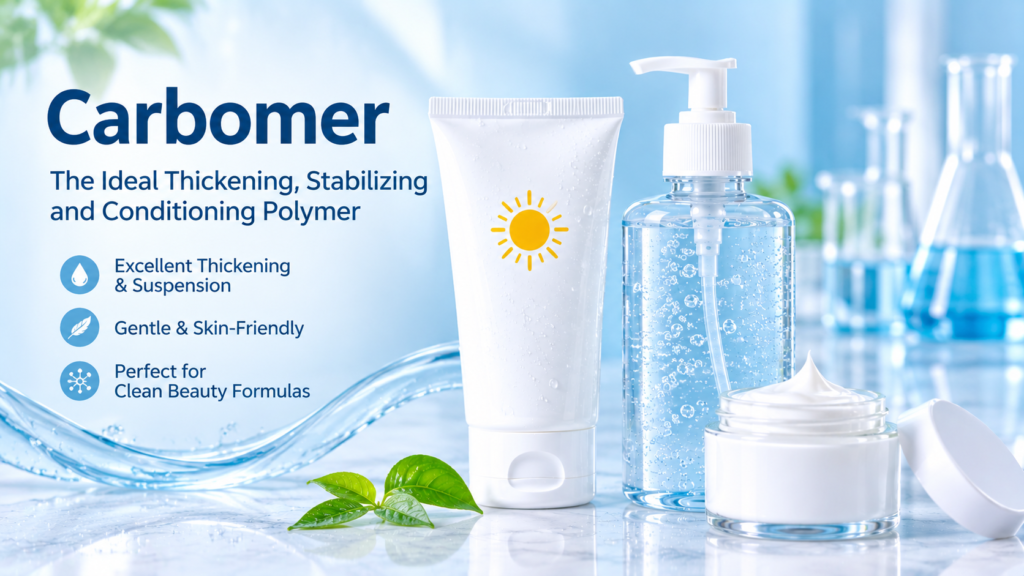
Carbomer is one of the most widely used rheology modifiers in the cosmetics and personal care industry. Known for its excellent thickening, stabilizing, and suspension properties, it helps formulators develop smooth and stable products, including facial gels, serums, sunscreens, and alcohol-based hand sanitizers.
However, different carbomer grades offer different rheological properties. Choosing the wrong grade may result in poor viscosity, particle sedimentation, reduced transparency, or pilling during application.
In this guide, we explore common carbomer grades, their applications, and practical tips for selecting the right carbomer for different formulations.
1. What Is Carbomer?
Carbomer is a family of crosslinked polyacrylic acid polymers widely used as thickening agents, stabilizers, and suspending agents.
When dispersed in water and neutralized with an alkaline ingredient, carbomer polymer chains expand and form a three-dimensional network, increasing formulation viscosity.
Common neutralizers include:
- Triethanolamine (TEA)
- Sodium hydroxide
- Aminomethyl propanol (AMP)
- Potassium hydroxide
Its main functions include:
- Thickening: Increases viscosity at relatively low concentrations.
- Suspension: Helps prevent insoluble particles from settling.
- Stabilization: Improves the consistency and physical stability of gels, creams, and lotions.
2. Common Carbomer Grades and Rheological Properties
Different carbomer grades provide different viscosity, flow behavior, suspension performance, and electrolyte compatibility.
GRADE | Main Characteristics | Typical Applications |
Carbomer 940 | High viscosity, excellent clarity | Transparent gels, serums |
Carbomer 980 | High viscosity, good clarity | Clear gels, hand sanitizers |
Carbomer 934 | High viscosity, strong gel structure | Creams, pharmaceutical gels |
Carbomer 941 | Lower viscosity, long-flow properties | Lotions, fluid gels |
Carbomer 974P | Pharmaceutical-grade polymer | Topical pharmaceutical products |
Ultrez 10 | Easy dispersion, excellent clarity | Clear and hydroalcoholic gels |
Ultrez 21 | Versatile rheology, good suspension | Gels, lotions |
Understanding Carbomer Rheology
Three parameters are particularly important:
Viscosity: Measures resistance to flow. Higher viscosity generally produces a thicker gel.
Yield Stress: Represents the minimum stress required for a structured gel to begin flowing. It is especially important for suspending mineral particles and exfoliating beads.
Flow Behavior: Some grades produce short-flow, structured gels, while others create longer-flow, easily spreadable textures.
Importantly, higher viscosity does not always mean better suspension performance. Both viscosity and yield stress should be evaluated.
3. Main Applications of Carbomer
Transparent Gels
Carbomer is commonly used in aloe vera gels, moisturizing serums, facial gels, and transparent hand gels. Carbomer 940, 980, and Ultrez 10 are common starting options when clarity and smooth texture are required.
Particle Suspension
Carbomer helps maintain the distribution of insoluble ingredients, including titanium dioxide, zinc oxide, mineral pigments, silica, and exfoliating beads. Its structured network helps reduce particle sedimentation.
Sunscreen Formulations
Carbomer improves viscosity, texture, and physical stability. However, electrolytes and mineral UV filters may affect its performance. Specialized electrolyte-tolerant polymers may be more suitable for challenging sunscreen formulations.
4. How to Choose the Right Carbomer Grade
Product Type | Suggested Grades | Key Considerations |
Transparent gels | 940, 980, Ultrez 10 | Clarity and viscosity |
Alcohol-based hand sanitizers | 980, Ultrez 10 | Alcohol compatibility |
High-electrolyte sunscreens | Specialized polymer grades | Electrolyte tolerance |
Exfoliating gels | 980, Ultrez 21 | Suspension and yield stress |
Pharmaceutical gels | Pharmaceutical grades | Purity and compliance |
These grades should be confirmed through compatibility and stability testing.
5. Expert Formulation Questions
Q1. Which Carbomer Grade Is Best for High-Transparency Sunscreen Gels or Alcohol-Based Hand Sanitizers to Minimize Pilling?
Pilling, also known as rolling or balling, occurs when a product forms small particles or rolls off the skin during application.
It can result from excessive polymer concentration, incompatible film-forming ingredients, poor hydration, or interactions between formulation components.
For alcohol-based hand sanitizers:
Carbomer 980 and Ultrez 10 are good starting options for transparent hydroalcoholic gels. Ultrez 10 offers easy dispersion and excellent clarity, while Carbomer 980 is suitable when a structured, high-viscosity gel is desired.
For high-transparency sunscreens:
Electrolyte compatibility is particularly important. Conventional carbomers may lose viscosity in high-salt systems. Consider specialized electrolyte-tolerant polymers or suitable polymer combinations.
To reduce pilling:
- Avoid excessive polymer concentration.
- Optimize neutralization and final pH.
- Check compatibility with film-forming ingredients.
- Evaluate interactions with sunscreen filters, silicones, and emollients.
- Test spreading and skin feel in the finished formulation.
Recommendation: Start by evaluating Carbomer 980 and Ultrez 10 for alcohol-based gels. For high-electrolyte sunscreens, prioritize electrolyte tolerance and overall formulation compatibility.
Q2. What Yield Stress Is Required to Prevent Mineral Particles or Exfoliating Beads from Settling?
Viscosity alone cannot guarantee long-term suspension. Yield stress is particularly important because it determines how well a structured gel resists the movement of suspended particles.
The required value depends on particle size, density, concentration, and storage conditions.
For initial laboratory screening, consider the following experimental ranges:
Yield Stress | Screening Application |
2–5 Pa | Fine, lightweight particles |
5–10 Pa | Moderate suspension requirements |
10–20 Pa | More challenging particle systems |
Above 20 Pa | Heavy or difficult-to-suspend particles |
These are suggested experimental screening ranges, not universal industry standards or guaranteed stability limits.
For reliable evaluation:
- Prepare samples with different carbomer concentrations.
- Adjust each sample to the target pH.
- Measure viscosity and yield stress using suitable rheological equipment.
- Add the required mineral particles or exfoliating beads.
- Conduct accelerated and long-term stability tests.
- Evaluate sedimentation, particle distribution, and redispersibility.
The goal is to achieve sufficient suspension without sacrificing spreadability or dispensing performance.
6. Pharmaceutical and Cosmetic Applications
Carbomer is widely used in both pharmaceutical and personal care products.
Pharmaceutical applications:
- Topical gels and creams
- Dermatological preparations
- Oral suspensions
- Mucoadhesive drug delivery systems
- Modified-release formulations
Cosmetic applications:
- Facial gels and moisturizing serums
- Face creams and body lotions
- Sunscreens
- Alcohol-based hand sanitizers
- Exfoliating gels
- Hair styling products
Pharmaceutical applications require appropriate grades that meet relevant purity and regulatory specifications.
7. Tips for Successful Carbomer Formulation
To achieve consistent performance, formulators should consider four factors:
- Dispersion: Add carbomer gradually into the aqueous phase to minimize lump formation.
- Neutralization: Select a suitable neutralizer and optimize final pH.
- Compatibility: Evaluate interactions with alcohol, electrolytes, surfactants, preservatives, and active ingredients.
- Stability: Test viscosity, clarity, suspension, and product appearance under different storage conditions.
Conclusion
Carbomer is more than a conventional thickening agent. Its rheological properties make it valuable for thickening, suspension, and stabilization in cosmetic and pharmaceutical formulations.
For transparent gels, Carbomer 940, 980, and Ultrez 10 are useful starting options. For alcohol-based hand sanitizers, Carbomer 980 and Ultrez 10 are worth evaluating. For high-electrolyte sunscreens, specialized electrolyte-tolerant polymers may provide better performance.
For particle-containing products, yield stress should be considered alongside viscosity to achieve long-term suspension stability.
Ultimately, selecting the right carbomer grade requires understanding the formulation composition, processing conditions, and desired product performance.
Frequently Asked Questions
1. Which carbomer is best for transparent gels?
Carbomer 940, 980, and Ultrez 10 are common choices. Final clarity depends on formulation compatibility and processing.
2. Can carbomer be used in alcohol-based hand sanitizers?
Yes. Carbomer 980 and Ultrez 10 are commonly considered for hydroalcoholic gels.
3. Why does carbomer lose viscosity in high-salt formulations?
Electrolytes can interfere with the expanded polymer structure, reducing thickening efficiency.
4. What is the difference between viscosity and yield stress?
Viscosity measures resistance to flow, while yield stress represents the minimum stress required for a structured gel to begin flowing.
5. Can carbomer be used in pharmaceutical products?
Yes. Suitable pharmaceutical-grade carbomers are used in topical gels, creams, suspensions, and specialized drug delivery systems.