I. Introduction: The Rise of Gentle Cleansing in Personal Care
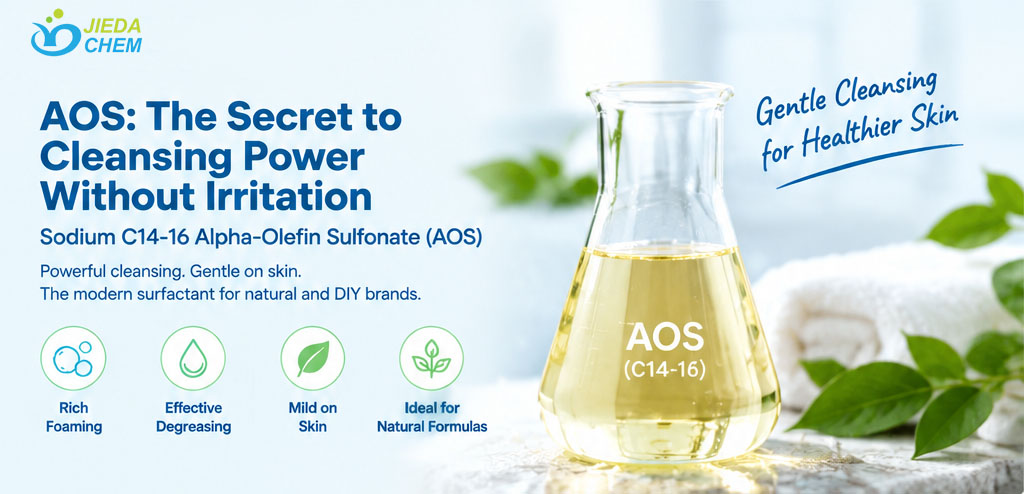
The beauty and personal care industry is undergoing a profound shift. Consumers are no longer satisfied with products that simply “get the job done” – they demand cleansing that is effective and skin-friendly. The growing demand for mild, sustainable, and transparent formulations has pushed formulators to rethink traditional workhorses like SLS and SLES.
Enter Sodium C14-16 Alpha-Olefin Sulfonate (AOS) – a modern surfactant that bridges the gap between powerful cleansing and skin compatibility. Derived from alpha-olefin sulfonates, AOS offers excellent foaming and degreasing without the harshness associated with older sulfate-based surfactants.
But here’s the key question: How can you balance strong cleansing with skin compatibility, especially for DIY and natural brands?
SEO Hook: “AOS: The Secret to Cleansing Power Without Irritation”
🔗 Related reading: Jieda Chem – Sodium C14-16 Alpha-Olefin Sulfonate (AOS) Product Page
II. What is Sodium C14-16 Alpha-Olefin Sulfonate (AOS)?
Definition: A sulfate-based surfactant derived from alpha-olefin sulfonates.
Chemical structure and source: AOS is a synthetic or semi-synthetic surfactant produced by sulfonation of alpha-olefins (typically C14-16 chain lengths). Unlike SLS/SLES, it does not contain ethoxylated residues, making it more appealing for clean-label formulations.
Physical properties:
-
Clear, pale yellow to colorless solution
-
Excellent foaming ability
-
Good wetting and emulsifying properties
-
Mild on skin compared to SLS and SLES
Key benefits:
-
Effective degreasing without over-stripping
-
Excellent performance in shampoos and body washes
-
More gentle than SLS and SLES
-
Better compatibility with natural ingredient systems
-
Good hard water tolerance
🔗 Learn more: Jieda Chem – AOS Technical Specifications & Applications
III. AOS vs SLES vs SLS: Comparative Analysis for Mild Cleansing
All three are sulfate-based surfactants, but their performance and safety profiles differ significantly.
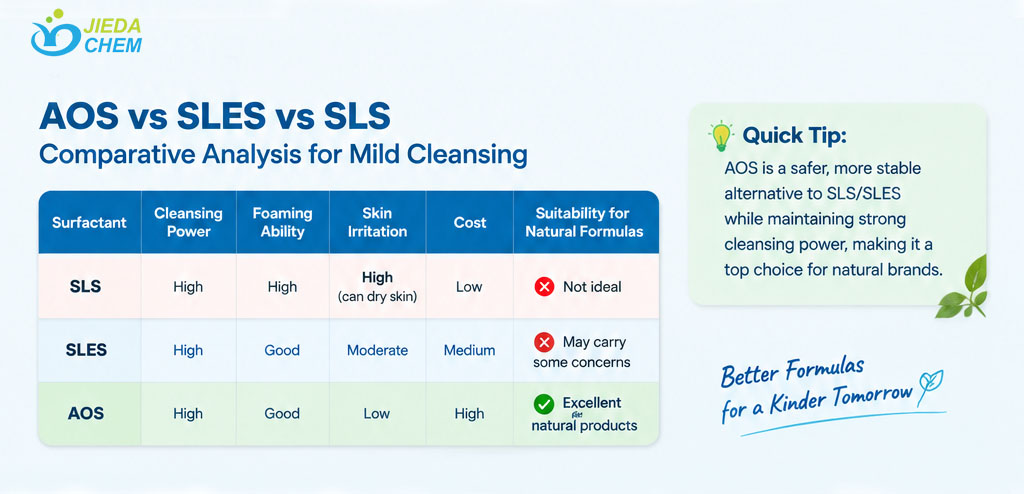
💡 Quick Tip: AOS is a safer, more stable alternative to SLS/SLES while maintaining strong cleansing power, making it a top choice for natural brands wanting to deliver high performance.
🔗 Compare surfactants: Jieda Chem – Surfactant Comparison Guide
IV. Why AOS is Becoming the Preferred Surfactant for Natural and DIY Formulas
-
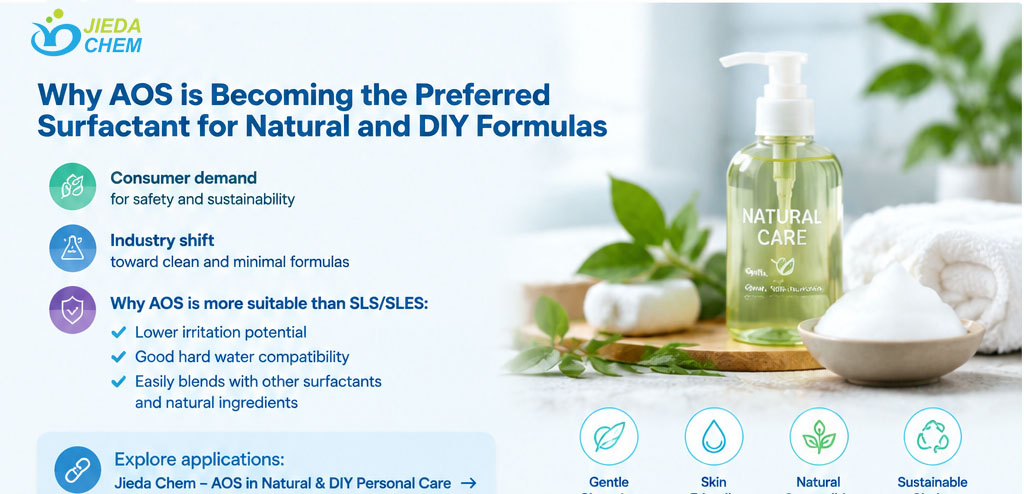
Consumer demand for safety and sustainability
-
Industry shift toward clean and minimal formulas
-
Why AOS is more suitable than SLS/SLES:
-
Lower irritation potential
-
Good hard water compatibility
-
Easily blends with other surfactants and natural ingredients
-
Best used in formulations with added mild surfactants to reduce harshness
-
🔗 Explore applications: Jieda Chem – AOS in Natural & DIY Personal Care
V. The Challenge: AOS May Cause Dryness in Final Products
Common issue: When replacing SLES with AOS, DIY formulators often notice dryness, tightness, or a lack of moisturizing effect.
Why this happens: AOS is a strong surfactant. While it is milder than SLS/SLES, its degreasing power can still strip natural oils from skin and hair if not properly balanced.
Solution: Formulation synergy is essential. You must pair AOS with co-surfactants and moisturizing agents to prevent dryness.
VI. How to Pair AOS with Other Surfactants to Prevent Dryness in Shampoos & Body Washes
The core reason AOS can feel drying is its strong degreasing power. To solve this, the strategy is simple: balance the skin feel through smart复配 (blending).
🧴 Best Combinations for Mildness and Skin Feel
1. Amphoteric Surfactants (Betaines – First Choice)
This is the most direct “smoothing” solution. Cocamidopropyl Betaine (CAB) significantly improves skin feel, reduces tightness, and helps stabilize foam. Patent literature also frequently combines Lauryl Hydroxysultaine with AOS to improve mildness and low-temperature stability.
2. Amino Acid Surfactants
This is the high-end mild route. Blending AOS with Sodium Lauroyl Sarcosinate or Potassium Cocoyl Glycinate dramatically improves the soft, moisturized feel after washing, prevents dryness, and maintains excellent foam quality.
3. Nonionic Surfactants (Auxiliary Thickening & Skin Feel)
Although nonionic surfactants mainly serve as thickeners and foam stabilizers, adding Alkyl Polyglucosides (APG) or Cocamide MEA (CMEA) can also improve the smoothness of skin feel after washing and help stabilize the formula.
4. Cationic Conditioning Agents (For Shampoos)
For shampoo formulas, surfactants alone cannot completely eliminate dryness. You need Polyquaternium-10 or Cationic Guar Gum. These cationic polymers adsorb onto negatively charged hair, providing wet and dry combing smoothness, fundamentally offsetting the dryness caused by AOS.
Expert Tip: Use lower concentration AOS and higher concentration mild co-surfactants to balance foaming and mildness.
Case Study: A DIY body wash using AOS + APG + humectants achieves rich lather while avoiding dryness.
🔗 Find co-surfactants: Jieda Chem – Mild Surfactant Blends & Betaines
VII. How to Maintain AOS Transparency in Cold Storage or Low-Temperature Environments
Issue: AOS can become cloudy or crystallized when stored at low temperatures.
Causes:
-
Temperature sensitivity of its molecular structure
-
Solubility changes in cold conditions
-
Reaching the “Krafft point” where AOS precipitates out
The core reason for low-temperature cloudiness is that AOS solubility decreases at low temperatures, falling below its Krafft point and precipitating out. To maintain long-term clarity, you cannot rely on “heating to recover” – you must intervene at the formulation stage.
❄️ Core Strategies and Additive Selection
1. Add Hydrotropes (Most Effective & Direct)
This is the first-choice solution for low-temperature cloudiness. Sodium Xylene Sulfonate (SXS) or Sodium Cumene Sulfonate (SCS) are the most commonly used hydrotropes. Adding 1%-3% can significantly lower the cloud point of surfactants, forcing AOS to remain dissolved at low temperatures and keeping the product clear and transparent.
2. Introduce “Anti-Freeze” Solvents
Adding Propylene Glycol (1%-3%) or Glycerin (2%-5%) can lower the freezing point of the water phase and increase AOS solubility at low temperatures. Urea is also a cheap and effective traditional solubilizing option, though its skin feel may be slightly inferior to polyols.
3. Blend with Surfactants with Good Low-Temperature Solubility
AES (Sodium Laureth Sulfate) generally has better low-temperature water solubility than AOS. Using partial AES to replace AOS (e.g., 10% SLES + 5% AOS blending approach) can significantly improve the low-temperature stability of the entire system, while leveraging AOS’s mildness to offset SLES’s irritation.
4. Control Raw Material Specifications and Process
When sourcing, pay attention to the Disulfonate (DS) content in AOS raw materials. Patents indicate that when DS content in AOS is maintained above 11%, it can effectively prevent the formation of lamellar micelles or liquid crystals due to temperature or concentration changes, thereby avoiding cloudiness and phase separation. Additionally, during production, ensure AOS is completely dissolved (can be heated to 60-70°C to dissolve, then cooled) and control finished product pH at 7.0-9.0 to help maintain long-term stability.
Expert Advice: Always test formulations at various temperatures to ensure performance in different climates.
🔗 Get hydrotropes & solvents: Jieda Chem – Hydrotropes and Solubilizing Agents
VIII. Application & Formulation Insights: AOS in a Modern Natural Product
For DIY shampoos and body washes, AOS can be used as a main surfactant or co-surfactant.
Formulation start point:
-
Start with 2–5% AOS as a base
-
Add 2–4% gentle surfactants (e.g., APG, Betaines)
-
Follow with hydrotropic agents (e.g., PEG-6, PEG-7, SXS, SCS) to maintain clarity and solubility
How to test for dryness or dry feeling in finished product:
-
Patch test on skin with low oil content
-
Monitor foam quality and user feedback on texture and moisturizing feel
🔗 Formulation support: Jieda Chem – Technical Formulation Resources
IX. Expert FAQ: Everything You Need to Know About Using AOS in Your Formulas
Q: Is AOS suitable for sensitive skin?
A: Yes, it’s mild and less irritating than SLS but stronger than APG or Betaines. Always use with co-surfactants.
Q: How does AOS perform in hard water?
A: AOS is highly compatible with hard water, making it ideal for regional product development.
Q: Can AOS be used in natural product formulas?
A: Yes, AOS is approved for use in natural or organic contexts when used in correct ratios.
Q: How do I avoid the clouding or crystallization of AOS when using for cold storage?
A: Use aqueous solutions, add hydrotropic agents (like SXS or SCS), introduce anti-freeze solvents (propylene glycol, glycerin), and avoid freezing temperatures in storage. Also, ensure AOS is fully dissolved during production and control pH to 7.0-9.0.
Q: What are the best stabilizers or co-surfactants to pair with AOS?
A: APG surfactants, Cocamidopropyl Betaine, amino acid surfactants, and PEGs are ideal for stability and mildness. For shampoos, add cationic conditioning agents like Polyquaternium-10.
🔗 More FAQs: Jieda Chem – AOS Frequently Asked Questions
X. Conclusion: AOS – The Future of Gentle, High-Performance Cleansing
Key takeaways:
-
AOS is mild but powerful for cleansing
-
It can be paired effectively with other surfactants to prevent dryness
-
It helps maintain clarity and stability, especially in cold conditions
-
Smart blending with betaines, amino acid surfactants, and hydrotropes solves both dryness and low-temperature cloudiness
Final call to action: “Ready to achieve a perfect balance of foam and mildness? Jieda Chem is here to help!”