
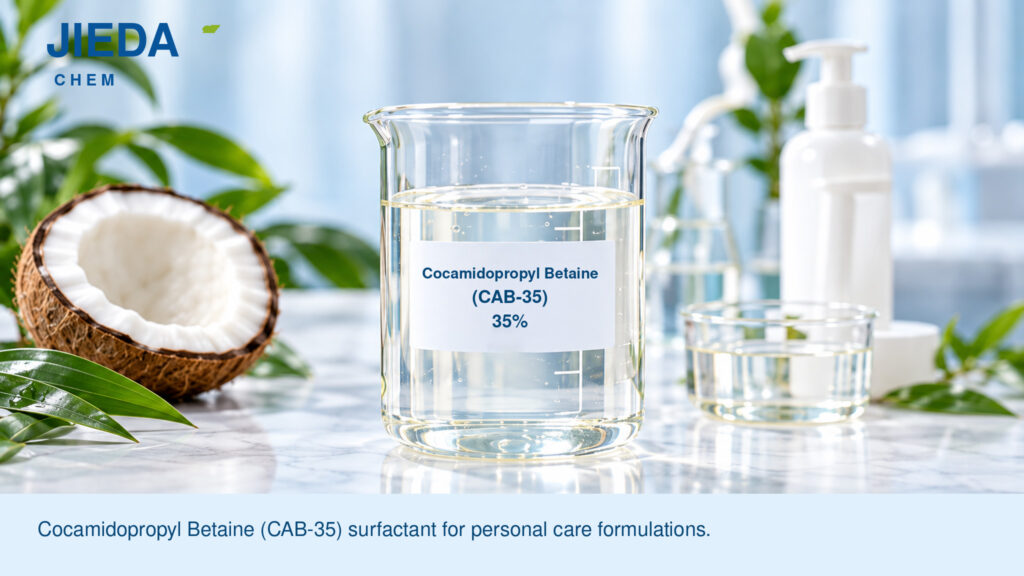
How can cosmetic formulators develop gentle, effective cleansers for sensitive skin without sacrificing rich foam and a pleasant cleansing experience? The answer often lies in selecting the right surfactant combination.
As consumers increasingly seek mild facial cleansers, baby shampoos, and gentle body washes, formulators must balance cleansing performance, foam quality, skin compatibility, and formulation stability. Cocamidopropyl Betaine (CAPB), commonly marketed as CAB-35 when supplied as a 35% solution, is a versatile amphoteric surfactant that can help achieve this balance.
When properly formulated with compatible surfactants, CAB-35 can improve foam quality, support viscosity development, and help create a milder cleansing system.
For cosmetic ingredient manufacturers and product developers, understanding how to use Cocamidopropyl Betaine in sensitive skin care is an important step toward developing effective, consumer-friendly personal care products.
1. What Is Cocamidopropyl Betaine (CAB-35)?
Cocamidopropyl Betaine (CAPB) is an amphoteric surfactant produced from coconut-derived fatty acids and other chemical raw materials. Its molecular structure contains both positively and negatively charged groups, allowing it to interact with different surfactant systems.
CAB-35 generally refers to a commercial aqueous solution containing approximately 35% active Cocamidopropyl Betaine. It is widely used in shampoos, facial cleansers, body washes, hand soaps, and other cleansing formulations.
Unlike a nonionic surfactant, CAPB is amphoteric. This distinction is important when selecting ingredients and predicting compatibility in a finished formulation.
Key Properties of CAB-35
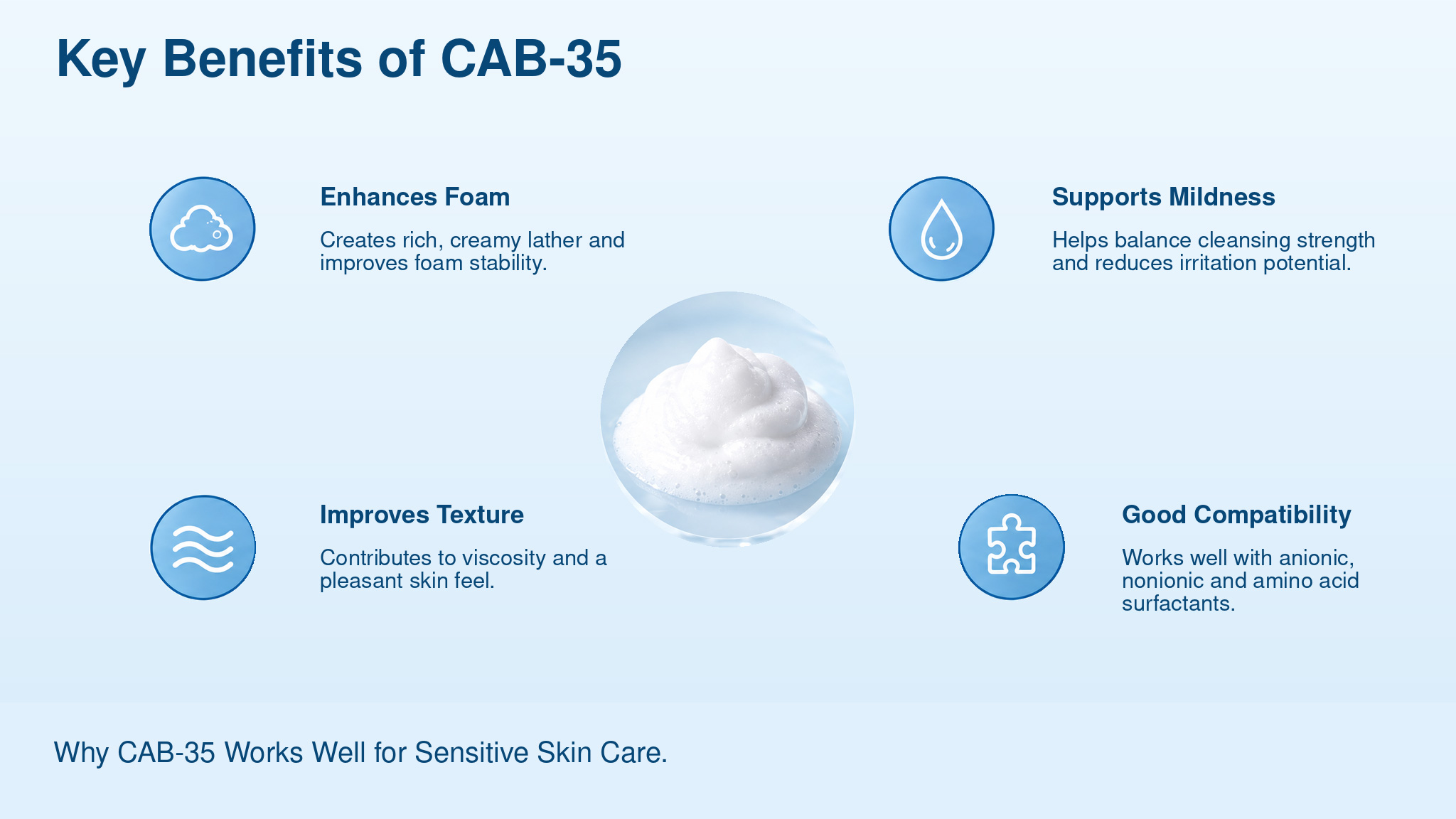
- Foam enhancement: Helps produce abundant, creamy foam and improves the overall lathering experience.
- Mildness support: Can help moderate the irritation potential of certain anionic surfactant systems when used at suitable concentrations.
- Viscosity development: Can contribute to the desired thickness of cleansing products, depending on the other ingredients and electrolyte balance.
- Formulation compatibility: Can be combined with many anionic, nonionic, and selected other surfactants.
- Versatile applications: Suitable for evaluation in facial cleansers, shampoos, body washes, and other rinse-off products.
For B2B formulators, the consistency of the raw material is just as important as its functionality. Active matter, pH, residual impurities, color, and viscosity can all influence the performance of the final product.
Jieda Chem supplies Cocamidopropyl Betaine in commercial concentrations including 30% and 35%, supporting a variety of personal care formulation requirements.
Learn more about the ingredient on the Jieda Chem Cocamidopropyl Betaine product page.
2. Why Does CAB-35 Work Well in Sensitive Skin Care Formulations?
Sensitive skin formulations require more than simply selecting ingredients described as mild. The entire cleansing system must be designed to remove dirt, excess oil, and product residue without unnecessarily compromising the skin’s comfort.
Cocamidopropyl Betaine can contribute to this balance in several ways.
2.1 Supporting a Milder Surfactant System
Strongly cleansing anionic surfactants, including sodium lauryl sulfate (SLS), can cause dryness or irritation under certain conditions. The actual effect depends on concentration, exposure time, the complete formula, and individual skin sensitivity.
Adding an appropriate amount of CAB-35 to an anionic surfactant system can modify its cleansing and foaming behavior and may reduce irritation potential compared with some single-surfactant systems.
However, CAB-35 does not automatically make every formula mild. The overall surfactant composition and the finished product’s performance must be evaluated.
2.2 Creating Soft, Creamy Foam
Foam quality is an important part of the user experience, particularly for facial cleansers, baby shampoos, and gentle body washes.
CAB-35 can improve foam volume and contribute to a denser, creamier lather when paired with suitable primary surfactants.
This enables formulators to pursue a pleasant cleansing experience without relying exclusively on a high concentration of a strong foaming surfactant.
2.3 Improving Product Texture
Consumers often associate a smooth, stable texture with a premium cleansing product. CAB-35 can contribute to viscosity development and formulation stability, although the final result depends on the entire ingredient system.
Salt concentration, pH, surfactant ratios, polymers, and other additives can significantly affect viscosity. Laboratory testing is therefore essential before finalizing the formula.
2.4 Choosing Ingredients Carefully
A mild cleansing system may combine CAB-35 with an appropriate amino acid-derived or other mild primary surfactant.
For example, Sodium Lauroyl Sarcosinate can be evaluated as a primary cleansing ingredient, while CAB-35 serves as a secondary surfactant to improve foam and overall formulation performance.
The objective is not simply to add more surfactants. It is to achieve the required cleansing efficacy and foam quality with a well-balanced system.
3. Understanding and Reducing Irritation in Sensitive Skin Cleansers
Even products marketed for sensitive skin can cause discomfort if their formulations are not properly balanced.
Potential contributors include:
- Excessive total surfactant concentration or unsuitable surfactant combinations.
- Prolonged contact with the skin or inadequate rinsing.
- Inappropriate pH or other formulation characteristics.
- Fragrances, preservatives, and other ingredients that an individual may not tolerate.
- Raw-material impurities that may contribute to allergic contact dermatitis.
The last point is particularly important when selecting Cocamidopropyl Betaine.
Raw-Material Quality Matters
Scientific assessments have identified dimethylaminopropylamine (DMAPA) and amidoamine as impurities associated with potential sensitization concerns in CAPB-containing products.
For this reason, formulators should consider more than the ingredient’s commercial concentration. Appropriate raw-material specifications, impurity controls, supplier documentation, and finished-product safety assessments are important parts of responsible formulation development.
A high active-matter concentration does not, by itself, establish that a material is purer or less irritating.
For sensitive skin applications, work with suppliers who can provide suitable technical documentation and quality information for the specific grade being considered.
The Cosmetic Ingredient Review’s safety assessment of Cocamidopropyl Betaine provides further scientific background on CAPB, its use in cosmetics, and the importance of controlling relevant impurities.
4. How to Formulate a Gentle Cleanser with CAB-35
Developing a low-irritation cleanser requires a systematic approach. The following recommendations provide a starting point for laboratory trials rather than a universally validated formula.
Step 1: Select a Suitable Primary Surfactant
Choose a primary cleansing ingredient according to the product’s purpose.
For a gentle facial cleanser, a mild amino acid-derived surfactant may be a suitable candidate. Sodium Lauroyl Sarcosinate is one option to evaluate, subject to the intended market, formulation requirements, and finished-product testing.
The primary surfactant should deliver sufficient cleansing performance without making the formula unnecessarily harsh.
Step 2: Add CAB-35 as a Secondary Surfactant
CAB-35 can be introduced to support foam quality, texture, and surfactant-system compatibility.
A useful initial screening range is approximately 2–5% of the supplied CAB-35 solution by weight, depending on the formulation.
Important: This range refers to the commercial raw material, not active surfactant matter. If the supplied grade contains 35% active matter, adding 2–5% CAB-35 contributes approximately 0.7–1.75% active CAPB to the finished formula.
This distinction is essential when calculating total surfactant concentration.
Step 3: Calculate Total Active Surfactant Matter
The total active surfactant concentration should be calculated from the active matter of every surfactant in the formula, not simply by adding the percentages of commercial raw materials.
For example, a formula containing 4% of a primary surfactant solution with 30% active matter and 3% CAB-35 with 35% active matter contributes:
- Primary surfactant: 4% × 30% = 1.20% active matter.
- CAB-35: 3% × 35% = 1.05% active matter.
- Total active matter from these two ingredients: 2.25%.
These calculations are illustrative. The appropriate total surfactant concentration depends on the intended product, cleansing performance, exposure, and safety assessment. There is no universal threshold below which irritation is guaranteed to be absent.
Step 4: Screen Different Surfactant Ratios
Rather than applying one fixed ratio to every product, develop several laboratory samples and compare their performance.
For example, a formulator might evaluate CAB-35 against a selected primary surfactant at different ratios while keeping the total active matter consistent.
Assess each sample for:
- Foam volume and creaminess.
- Cleansing efficacy and rinseability.
- Viscosity and texture.
- pH and physical stability.
- Skin compatibility and finished-product safety.
This approach helps identify a suitable balance between cleansing power, foam, and mildness.
Step 5: Optimize pH and Stability
Adjust the pH to the range appropriate for the intended product and the compatibility of its ingredients.
Check viscosity, appearance, odor, and phase behavior during stability testing. Where relevant, evaluate the formula under different storage temperatures and conduct preservative efficacy testing.
A formulation that looks stable immediately after production may behave differently during storage, so appropriate testing should precede commercialization.
Example of a Formulation Screening Plan
For an initial rinse-off facial cleanser, a development team could evaluate:
- A selected mild primary surfactant at several active-matter levels.
- CAB-35 at different addition rates.
- A suitable pH adjustment system.
- Water and any required compatible additives.
The team should then compare foam, cleansing performance, viscosity, stability, and skin compatibility before selecting a final formula.
This method is more reliable than assuming a particular ingredient ratio will automatically produce a non-irritating cleanser.
For further ingredient selection, explore Jieda’s Cocamidopropyl Betaine product information.
5. Practical Applications: CAB-35 in Baby and Sensitive Skin Products
CAB-35 is used in a range of rinse-off personal care products. Its role varies according to the product’s cleansing requirements and the other ingredients in the formulation.
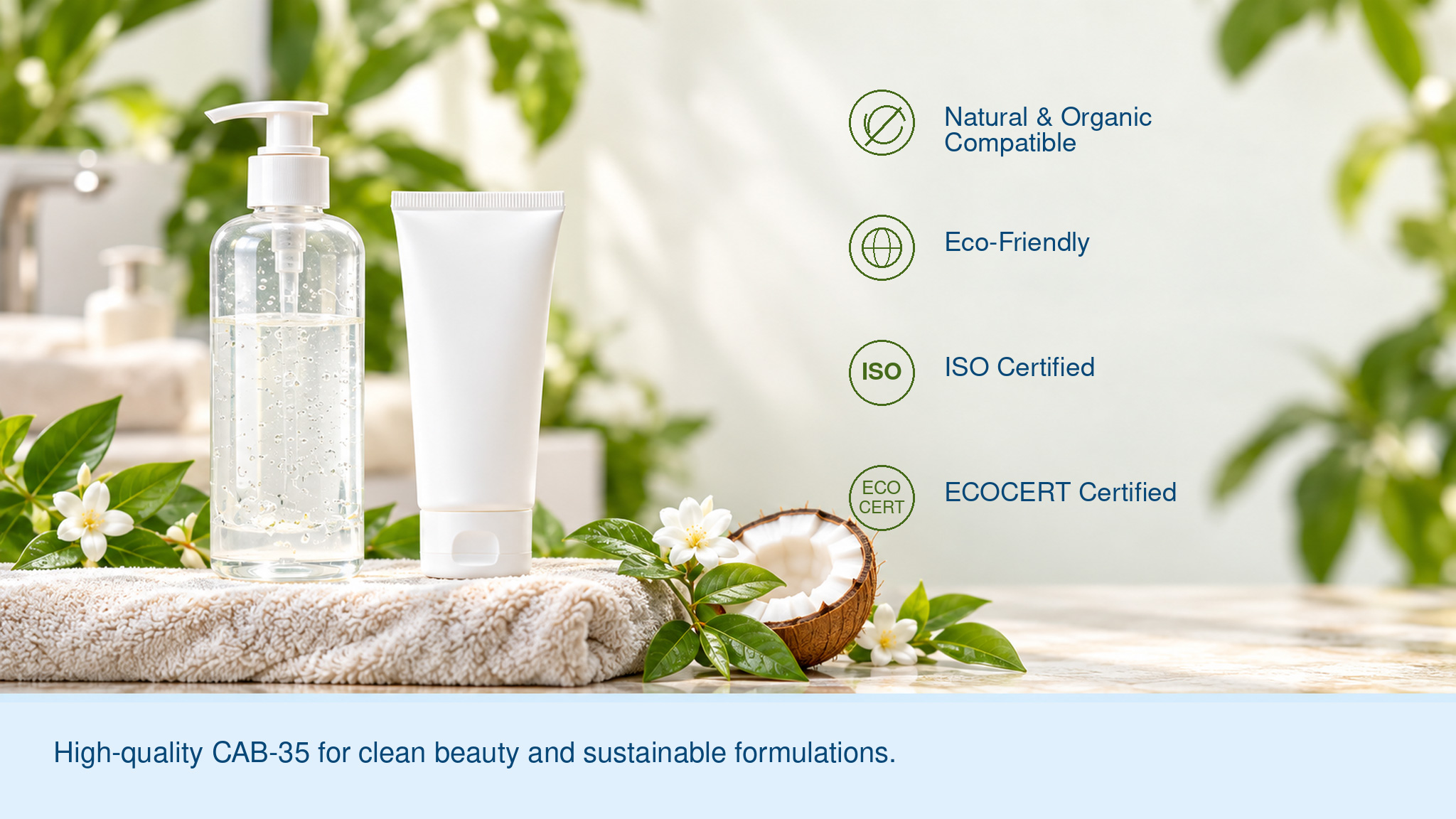
Baby Shampoo
Baby shampoos require careful balancing of cleansing performance, foam, rinseability, and eye-area exposure considerations.
CAB-35 may support foam and help modify the performance of a compatible primary surfactant system. However, the presence of CAB-35 alone does not establish that a shampoo is tear-free or suitable for every baby.
Finished-product safety and appropriate testing remain essential.
Gentle Facial Cleansers
Facial cleansers for sensitive skin often aim to remove dirt, sunscreen, and excess oil without leaving the skin feeling excessively tight.
A properly balanced CAB-35-containing system may help create a pleasant lather and improve the sensory properties of the product.
Formulators should assess cleansing efficacy alongside skin compatibility rather than treating foam volume as the sole indicator of performance.
Mild Body Washes and Hand Cleansers
In body washes and hand cleansers, CAB-35 can support foaming, texture, and compatibility with selected primary surfactants.
The optimal level depends on the required cleansing strength, frequency of use, intended user group, and other formulation ingredients.
Fragrance-Free and Sensitive-Skin Products
Fragrance-free formulations can be appropriate for consumers who wish to avoid fragrance-related reactions. Nevertheless, fragrance-free does not automatically mean hypoallergenic or non-irritating.
A sensitive-skin claim should be supported by appropriate ingredient review, safety assessment, and finished-product testing.
For baby care and sensitive-skin applications, Jieda can be approached for product specifications and technical information to help determine whether a particular CAB-35 grade is suitable for the intended formulation.
6. Best Practices for CAB-35 in Clean Beauty Formulations
The clean beauty market continues to place emphasis on ingredient transparency, effective cleansing, and consumer experience.
For cosmetic ingredient buyers and formulators, CAB-35 offers useful functionality, but ingredient selection should be based on evidence rather than marketing labels alone.
Evaluate the Complete Ingredient Profile
Terms such as “natural,” “eco-friendly,” “clean,” and “organic-certified” have different meanings and requirements.
Although CAPB can be manufactured using coconut-derived fatty acids, this does not automatically make the finished material entirely natural or eligible for every organic certification.
Verify the raw material’s documentation and applicable certification requirements before making claims.
Prioritize Quality and Traceability
When comparing suppliers, consider:
- Active matter and concentration.
- pH and other relevant specification limits.
- Relevant impurity-control information.
- Batch-to-batch consistency.
- Technical data sheets and safety data sheets.
- Applicable regulatory and certification documentation.
For sensitive-skin products, these factors can be as important as foam performance and cost.
Test the Finished Product
A surfactant’s properties do not fully predict the performance of the finished formulation.
Conduct appropriate stability, microbiological, packaging compatibility, and safety evaluations. Where claims such as “for sensitive skin” or “hypoallergenic” are intended, ensure they are adequately substantiated for the target market.
For B2B development teams, a structured evaluation process helps reduce formulation risk and supports more reliable product launches.
7. Frequently Asked Questions About CAB-35 in Sensitive Skin Care
Is Cocamidopropyl Betaine suitable for sensitive skin?
CAB-35 can be used in formulations designed for sensitive skin, provided the complete formulation is appropriately designed and evaluated. Some individuals may develop irritation or allergic contact dermatitis associated with CAPB-containing products, so universal claims of non-irritation should be avoided.
What is the difference between CAB-35 and CAPB?
CAPB stands for Cocamidopropyl Betaine, the surfactant’s common ingredient name. CAB-35 generally refers to a commercial solution containing approximately 35% active matter. The precise specification should always be confirmed with the supplier.
What is the recommended CAB-35 dosage for a gentle facial cleanser?
A preliminary screening range of 2–5% supplied CAB-35 may be useful for some formulations. The actual dosage depends on the raw material’s active concentration, the primary surfactant, total active matter, and the required product performance.
This is a development starting point, not a universal recommendation for all facial cleansers.
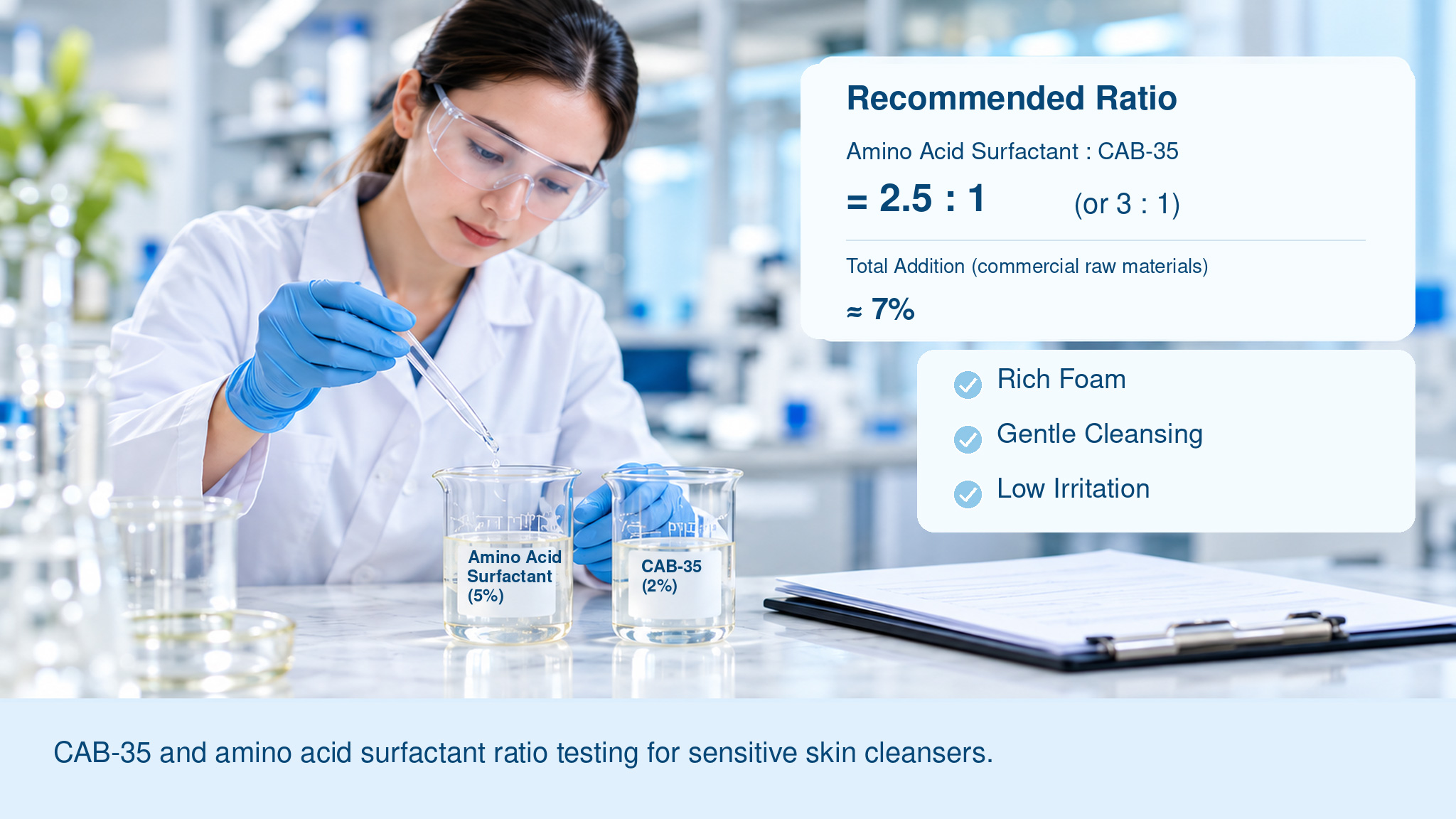
Can CAB-35 be combined with amino acid surfactants?
Yes. CAB-35 can be evaluated in combination with compatible amino acid-derived surfactants to balance cleansing performance and foam quality. The best combination and ratio should be established through laboratory testing.
Can CAB-35 reduce irritation caused by SLS or AOS?
CAB-35 may help moderate the irritation potential of certain anionic surfactant systems. However, the outcome depends on the complete formulation, ingredient concentrations, and testing conditions. Adding CAB-35 does not guarantee that an SLS- or AOS-containing product will be non-irritating.
Is CAB-35 suitable for baby shampoo?
CAB-35 is used in some baby shampoo formulations. Suitability depends on the full ingredient system, product design, intended use, and safety assessment. The ingredient alone does not establish that a product is tear-free or safe for every infant.
What should buyers look for when sourcing CAB-35?
Buyers should confirm active matter, product specifications, impurity controls, batch consistency, technical documentation, and the supplier’s ability to support the intended application.
For sensitive-skin formulations, these details help the development team assess raw-material suitability more effectively.
Conclusion: Develop Better Sensitive-Skin Cleansers with CAB-35
Cocamidopropyl Betaine (CAB-35) is a versatile amphoteric surfactant that can help formulators develop cleansing products with rich foam, pleasant texture, and balanced cleansing performance.
When combined with a suitable primary surfactant and used at an appropriate concentration, it can be a valuable component in facial cleansers, baby shampoos, and gentle body washes.
However, successful sensitive-skin formulation depends on more than one ingredient. Raw-material quality, active-matter calculations, impurity control, pH, formulation stability, and finished-product safety testing all contribute to the final result.
Jieda Chem supplies Cocamidopropyl Betaine in 30% and 35% commercial concentrations for personal care and cleansing applications. By evaluating the appropriate grade and formulation conditions, product developers can make more informed decisions when designing their next cleansing product.
Looking for a suitable CAB-35 grade for your next formulation?
Contact Jieda Chem to request product specifications, discuss your application requirements, and explore sample availability and formulation support.
Together, let’s develop effective, well-balanced cleansing formulations for today’s personal care market.